
Photographing in Iceland: Volcanic eruption and Northern Lights
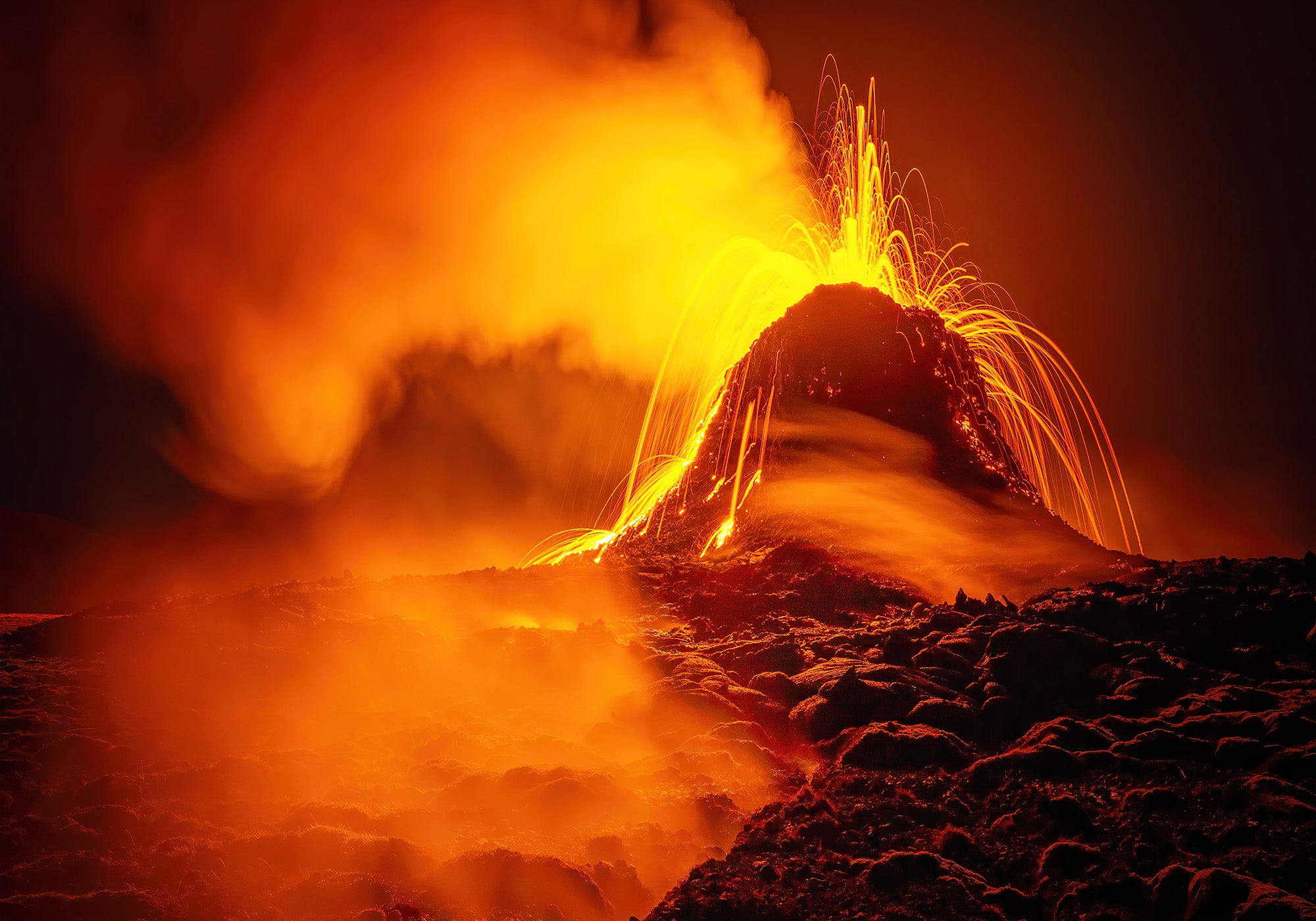
When the Fagradalsfjall volcano erupted in March 2021, we were able to witness up close the dramatic primordial violence that shaped our planet. The volcano's location and accessibility allowed people to visit the eruption site and marvel at and document the sheer power and wonder of our planet. When Stefan Liebermann in Germany saw the images, he knew he had to go and see the eruption with his own eyes.
The original article can be found at: https://www.sony.de/alphauniverse/stories/shooting-iceland-with-the-sony-alpha-7c .

Traveling abroad in the middle of the Covid-19 pandemic came with some obstacles. “When we arrived, we had to be quarantined for five days,” says Stefan, “but when we were able to photograph the outbreak, wow, that was crazy!”
Stefan arrived when the first fissure of the eruption was active, but as the second fissure opened, access to the area became difficult due to increasing danger.

“Entering the area was absolutely forbidden,” said Stefan. “No one was there and the police told people to stay away. Luckily, my friend and I had German press passes. We spoke to the police and they allowed us to take photos, but at our own risk.”

Stefan normally shoots landscapes and space with his Sony α7R III and his α7 III, but for this adventure in Iceland he chose the Sony α7C. It is the smallest full-frame mirrorless camera with the same 24.2 megapixel sensor as the Sony α7 III.

Stefan chose his FE 16-35mm f/2.8 G Master and 135mm f/1.8 G Master lenses for this trip to Iceland. With the super wide-angle lens, Stefan was able to capture the vastness of any landscape, especially when taking astrophotography of the Northern Lights. The long focal length also makes the foreground clear, providing additional depth and width while giving the viewer the feeling of being there.

“Apart from two Italian scientists who were taking measurements, there was no one at the second column,” he remembers. “They had all this safety equipment and we had nothing.”
“I didn't realize it at the time, but I had minor burns on my face from the heat of the lava and after a day of shooting, the lens hood on my FE 16-35mm f/2.8 G Master lens had started to warp in the heat and to melt. But despite these extreme conditions, the performance of the camera and lenses was perfect!”

Likewise, in another Iceland image, Stefan uses a simple bird flying through the scene to represent the size of the Skógafoss waterfall.

Taking photos in Iceland, especially when he was able to capture an active volcano, filled Stefan with wonder. “It was exciting, I felt like a child,” he says with a laugh. “As professional photographers, we may be too used to photographing the same things over and over again, but this was something completely new. I photographed many hundreds of different images, all from different angles, trying to capture the perfect image to capture this spectacular landscape.


Leave a comment
Comments will be approved before showing up.
Also in Stories

Combining landscape and astrophotography - Traveling in the American Southwest
As the sunset fades over the swirling sandstone formations of White Pocket, Arizona, photographer Stefan Liebermann waits for the Milky Way to emerge above him. On the road in the Southwestern United States with the Sony 28-70mm F2.0.

My recording technique | Deep Sky

Stefan Liebermann
Author